
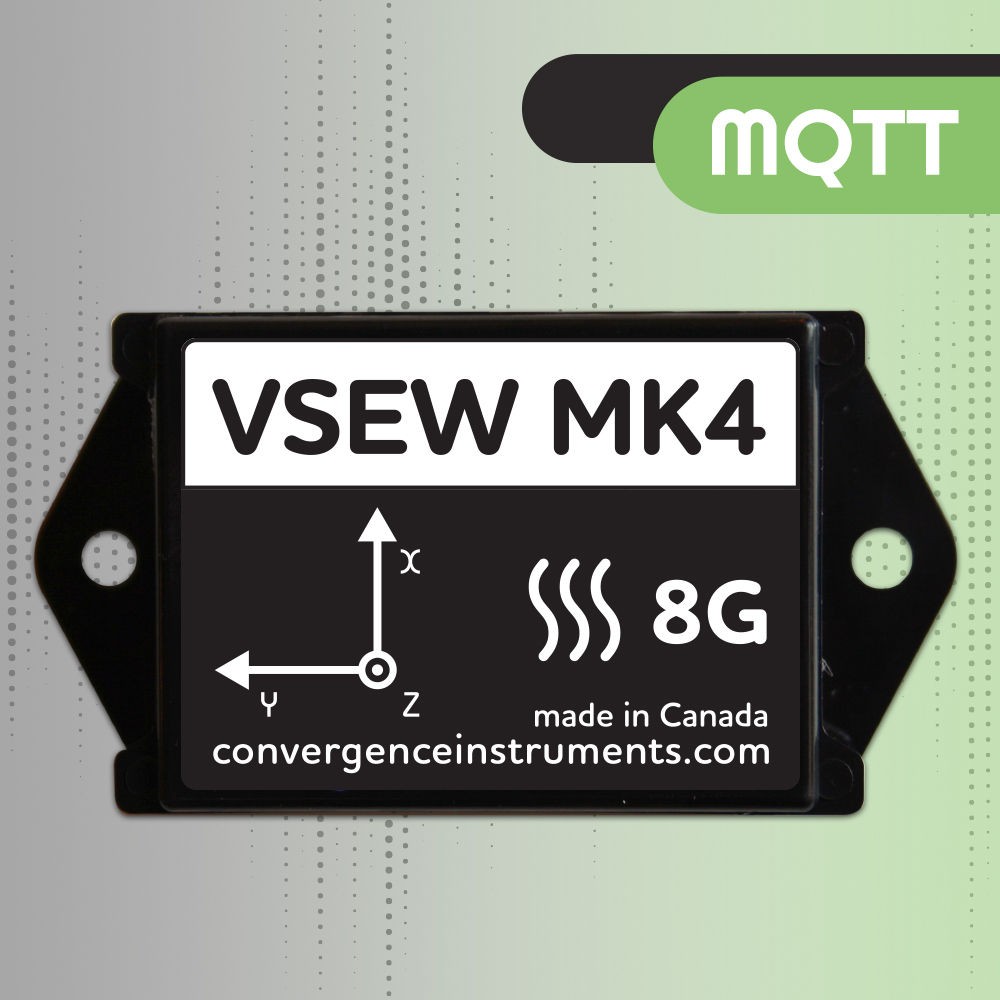


VSEW_mk4_MQTT

574.00 $

SKU VSEW-mk4-mqtt Category Tags ,
FCC CE Certified IP57 Waterproof Rating
🔌
Built for developers and OEMs.
Open MQTT wireless protocol. Publish vibration data directly to your own broker, cloud platform or IoT system. Fully documented protocol: VSEW_mk4 MQTT Protocol.

The Wireless Vibration Meter Data Logger – VSEW_mk4 – MQTT is similar in form, function and performance to the VSEW_mk4 8g. It has been designed with an open wireless protocol based on MQTT, for developers and OEMs who need to integrate it to their own platform while using wireless connectivity.

The instrument publishes recorded data (acceleration, velocity, vibration levels, inclinations) and vital signs to any standard MQTT broker. The communication protocol is fully documented.

VSEW mk4 MQTT vs Standard Models

  • Open MQTT wireless protocol — publish to any standard broker
  • Same hardware, sensor and noise floor as the VSEW mk4 8g
  • Virtual COM port interface for USB configuration (Com Protocol)
  • Preset filters support DIN4150-2, DIN4150-3 and ISO 2631-2 standards
  • No proprietary email alerts — use your own notification system via MQTT

VSEW mk4 MQTT Applications

  • Integration into custom IoT vibration monitoring platforms
  • OEM embedding in industrial equipment and machinery
  • Building-health monitoring with third-party dashboards
  • Multi-sensor networks publishing to a central MQTT broker
  • Long-term measurement of acceleration, velocity, statistics and RMS levels

This instrument is similar in form, function and performance to the VSEW_mk4. It has been designed with an open wireless protocol based on MQTT, for developers and OEMs who need to integrate it to their own platform while using wireless connectivity.

FCC CE
See the VSEW_mk4 for specific information about the instrument itself.
🔌 Why the VSEW mk4 MQTT?
Open MQTT protocol — publish to any standard broker
±8 g dynamic range — same sensor as the VSEW mk4 8g
Fully documented — MQTT + USB VCP protocols open
3-axis MEMS — acceleration + velocity + inclination
128 Mb memory — months of continuous recording
IP57 sealed — weatherproof, 65 g, deploy anywhere
Key Features
The VSEW mk4 MQTT combines professional vibration sensing with an open wireless protocol — designed for developers and OEMs who need full integration control.
🔌
Open protocol

MQTT Wireless Protocol

Publish vibration data directly to any standard MQTT broker. Integrate with AWS IoT, Azure, Home Assistant, Node-RED, or your own custom platform. Fully documented protocol.

📊

Ultra-Low Noise Floor

Same ±8 g sensor and 110 μg RMS noise floor as the VSEW mk4 8g. Detects subtle structural vibrations, seismic activity and early-stage machinery wear.

📋

DIN4150-2 & ISO2631-2

Built-in preset filters for direct support to vibration standards. Results accessible via MQTT topics — feed directly into your compliance reporting system.

🛡️

IP57 Weatherproof & 65 g

Integrally potted ABS enclosure protected against dust and temporary immersion. Compact enough to embed inside OEM products or deploy at remote outdoor sites.

Product Description

The Wireless Vibration Meter Data Logger – VSEW_mk4 – MQTT is similar in form, function and performance to the VSEW_mk4 8g. It has been designed with an open wireless protocol based on MQTT, for developers and OEMs who need to integrate it to their own platform while using wireless connectivity.

The instrument publishes recorded data (acceleration, velocity, vibration levels, inclinations) and vital signs to any standard MQTT broker. It includes a 3-axis MEMS accelerometer, an accurate date/time clock and a non-volatile 128 Mb recording memory.

🔌 Key Differences vs Standard VSEW mk4
  • Open MQTT wireless protocol instead of proprietary WiFi reporting MQTT
  • Publishes to any standard MQTT broker (Mosquitto, AWS IoT, Azure, HiveMQ, etc.)
  • No built-in email alerts — implement your own notification logic via MQTT
  • Same sensor, same noise floor, same mechanical design as the VSEW mk4 8g

VSEW mk4 MQTT Applications

  • Integration into custom IoT vibration monitoring platforms
  • OEM embedding in industrial equipment and machinery
  • Building-health monitoring with third-party dashboards
  • Multi-sensor networks publishing to a central MQTT broker
  • Long-term measurement of acceleration, velocity, statistics and RMS levels

MQTT Protocol Integration

The VSEW mk4 MQTT connects to any standard MQTT broker over WiFi and publishes vibration data on configurable topics. The protocol is fully documented in the VSEW_mk4 MQTT Protocol document.

Published Data

  • Acceleration signals (raw or statistics) on X, Y, Z axes
  • Velocity signals (raw or statistics) on X, Y, Z axes
  • RMS vibration and velocity levels
  • Inclination measurements
  • Instrument vital signs (battery voltage, temperature)

Example MQTT Topic Structure

convergence/{device_id}/acceleration
convergence/{device_id}/velocity
convergence/{device_id}/rms_level
convergence/{device_id}/inclination
convergence/{device_id}/vitals

Compatible Brokers & Platforms

  • Eclipse Mosquitto, HiveMQ, EMQX
  • AWS IoT Core, Azure IoT Hub, Google Cloud IoT
  • Node-RED, Home Assistant, Grafana
  • Any standard MQTT 3.1.1 broker

The USB Virtual COM port interface (Com Protocol) is also available for local configuration and data transfer.

Specifications

Sensor
Number of Axes3
Acceleration SensorMEMS Digital 3-axis
Dynamic Range±8 g (same sensor as VSEW mk4 8g)
Bandwidth High LimitAdjustable up to 2 kHz (@ 4 kHz Sampling Rate)
Bandwidth Low LimitDC (High-Pass Filter Bypass), Adjustable from 10 mHz to Fs/2 (High-Pass Filter On)
Noise Performance
Accel. Noise (Typical – flat response)110×10⁻⁶ g RMS @ 125 Hz Sampling Rate
750×10⁻⁶ g RMS @ 4 kHz Sampling Rate
Accel. Noise (band-limited 1Hz–100Hz)200 μg RMS @ 4 kHz Sampling Rate
Velocity Noise (Typical – flat response)35 μm/s RMS @ 1 Hz High-Pass Cutoff
12 μm/s RMS @ 10 Hz High-Pass Cutoff
Connectivity
Wireless ProtocolOpen MQTT — publishes to any standard MQTT 3.1.1 broker
USBVirtual COM port interface with open protocol
WiFi Radio StandardIEEE 802.11 b/g/n (2.4 GHz-only transceiver)
WiFi Band2.4 GHz band (Channels 1 to 11, 2412 MHz to 2462 MHz)
WiFi Max Power100 mW (20 dBm)
Email AlarmsNot available — use MQTT subscriptions for custom alerts
Measurements
MeasurementsRaw Acceleration (g or m/s²), Raw Velocity (m/s), Min/Max/Avg Acceleration, Min/Max/Avg Velocity, Inclinations, Min/Max/Avg RMS Vibration level (linear or dB), Min/Max/Avg RMS Velocity level (linear or dB)
Spectral Display3-Axes 1024-point Power Spectrum — dB or Lin Scale
Recording
Duty Rate100% — No Missed Samples
Recording MemoryNon-Volatile Flash Memory — 128 Mb
Recording Capacity Examples17 min single-axis raw signals @ 4 kHz
5 days 3-axes full-statistics @ 1 s intervals
10 months 3-axes full-statistics @ 1 min intervals
Data Retention> 20 Years
Power
Battery TypeIntegral Li-Poly — USB-Rechargeable
Battery AutonomyUp to 1 year in Idle
16 to 125 days while recording, depending on settings
Physical
Temperature Range−20 °C to 60 °C (−4 °F to 140 °F)
Weight65 g
IP RatingIP57 — Protected against dust and temporary immersion

Talk to an expert

OR

CALL US: 819-575-1990

Mon-Fri 9am-5pm EST

Which Model to Choose?

Which Vibration Meter Is Right for You?
Compare all Convergence Instruments vibration meters side by side
VSEW mk4 8g VSEW mk4 40g VSEW mk4 200g VS E-16g mk4 MQTT
This product
Product Page View → View → View → View →
Sensor & Range
Dynamic Range±8 g±40 g±200 g±16 gDepends on model
Memory128 Mb128 Mb128 Mb128 Mb128 Mb
Measures Velocity
Connectivity & Alerts
Open USB Protocol (VCP)
WiFi Reporting
Email Alarms
Visual Alarms
Features
Timer Start
High-Precision Trigger (80 ms Pretrig)
Time Zone Aware
Settings Retained Through Reset
Target Application
ImpactsDoM
Shipment MonitoringDoM
InclinometerDoM
Low-Amplitude VibrationsDoM
Ground Vibrations / ConstructionDoM
DIN4150-2DoM
Machine MonitoringDoM
Raw-Signal Recording
Noise Floor
X-Y Axes 110 μg @ 125 Hz
750 μg @ 4 kHz
200 μg RMS acceleration noise RMS @ 4kHz sampling rate (band-limited to 1Hz-100Hz)
800 μg @ 125 Hz
4 mg @ 4 kHz
31 mg @ 100 Hz
125 mg @ 3.2 kHz
2 mg @ 100 Hz
10 mg @ 3.2 kHz
DoM
Z Axis 110 μg @ 125 Hz
750 μg @ 4 kHz
200 μg RMS acceleration noise RMS @ 4kHz sampling rate (band-limited to 1Hz-100Hz)
800 μg @ 125 Hz
4 mg @ 4 kHz
36 mg @ 100 Hz
160 mg @ 3.2 kHz
3.6 mg @ 100 Hz
16 mg @ 3.2 kHz
DoM
Built for Integration
The VSEW mk4 MQTT is designed for developers and OEMs who need to integrate professional vibration sensing into their own platforms and products.
🔌

Custom IoT Platforms

Publish vibration data to your own MQTT broker and build custom dashboards with Grafana, Node-RED, or your proprietary platform. Full control over data flow, storage and alerting logic — no vendor lock-in.

MQTT Grafana Node-RED Custom dashboard
⚙️

OEM Product Integration

Embed the VSEW mk4 MQTT inside your own industrial equipment, monitoring systems or turnkey solutions. At 65 g and IP57, it fits inside enclosures and housings. Your customers see your brand — the sensor works silently underneath.

OEM White-label 65 g IP57
☁️

Cloud Service Providers

Connect directly to AWS IoT Core, Azure IoT Hub, Google Cloud IoT or any MQTT-compatible cloud service. Build scalable vibration monitoring solutions for your clients without developing the sensor hardware from scratch.

AWS IoT Azure Google Cloud Scalable
🏗️

Multi-Sensor Networks

Deploy dozens of VSEW mk4 MQTT devices across a site, all publishing to one central broker. Build a distributed vibration monitoring mesh for construction sites, industrial facilities or infrastructure projects — with your own alerting and compliance logic.

Distributed Multi-sensor DIN4150-2 Custom alerts
0.0
Based on 0 reviews
5 star
0%
4 star
0%
3 star
0%
2 star
0%
1 star
0%
0 of 0 reviews

Sorry, no reviews match your current selections

Software Description Importance Download
Instrument Manager Universal Installer Instrument Management Software Essential Install BEFORE connecting the instrument
Instrument Listener Fast Connect Installer Must run on the server to receive and process incoming NSRT-W connections. Now includes the AutoCalc feature, which automatically calculates various metrics in batch and exports the data to a spreadsheet format Essential for WiFi connectivity on the server-side
Instrument RealTime Listener Must run on the server to allow any number of instruments to connect and present real-time data on the server’s display. Optional
Wave Analysis Installer Post-Analysis Tool Optional
Speed & Displacement Installer Post-Analysis Tool Optional
Instrument_Disk_Recorder An application to stream to disk vibration levels and raw acceleration signals Optional
PPV Analysis An application to calculate and display Peak Particle Velocity from acceleration or velocity recorded signals. Optional
VS Response Spectrum An application to calculate SDOF Response Spectra from data recorded by a Vibration Sentry device. Optional
Building Vibration Calculator An application to calculate compliance of recorded vibrations to standards for structural integrity of buildings. Optional
Auto Export An application to automatically export the recorded data to .txt files. Optional
Python Example Code Python library for parsing NSRTW_mk4 MQTT protocol messages (can also be used as a guide for VSEW_mk4_MQTT) Optional
VSEW_mk4-200g VS_E-16g VSEW_mk4-8g VSEW_mk4-40g mk4 MQTT Variants
Memory 128 Mb 128 Mb 128 Mb 128 Mb 128 Mb
Dynamic Range +-200g +-16g +-8g +-40g depends on model (DoM)
Measures Velocity *   * * *
Open USB protocol *   * * *
WiFi Reporting *   * * *
Email Alarms *   * *  
Visual Alarms   *      
Timer Start * * * * *
High-Precision Trigger with Guaranteed 80 ms Pretrig * * * * *
Time Zone Aware * * * * *
Retains Settings Through Reset or Battery Failure * * * * *
Target Application:
Impacts *       DoM
Shipment Monitoring * *   * DoM
Inclinometer   * *   DoM
Low-Amplitude Vibrations     *   DoM
Ground Vibrations/Construction     *   DoM
DIN4150-2     *   DoM
Machine Monitoring   * * * DoM
Raw-Signal Recording * * * * *
Noise Floor X-Y Axes 31 mgRMS @ 100Hz
125 mgRMS @ 3.2 kHz
2 mgRMS @ 100Hz
10 mgRMS @ 3.2 kHz
110 μgRMS @ 125Hz
750 μgRMS @ 4 kHz
800 μgRMS @ 125Hz
4 mgRMS @ 4 kHz
DoM
Noise Floor Z axis 36 mgRMS @ 100Hz
160 mgRMS @ 3.2 kHz
3.6 mgRMS @ 100Hz
16 mgRMS @ 3.2 kHz
140 μgRMS @ 125Hz
900 μgRMS @ 4 kHz
800 μgRMS @ 125Hz
4 mgRMS @ 4 kHz
DoM