
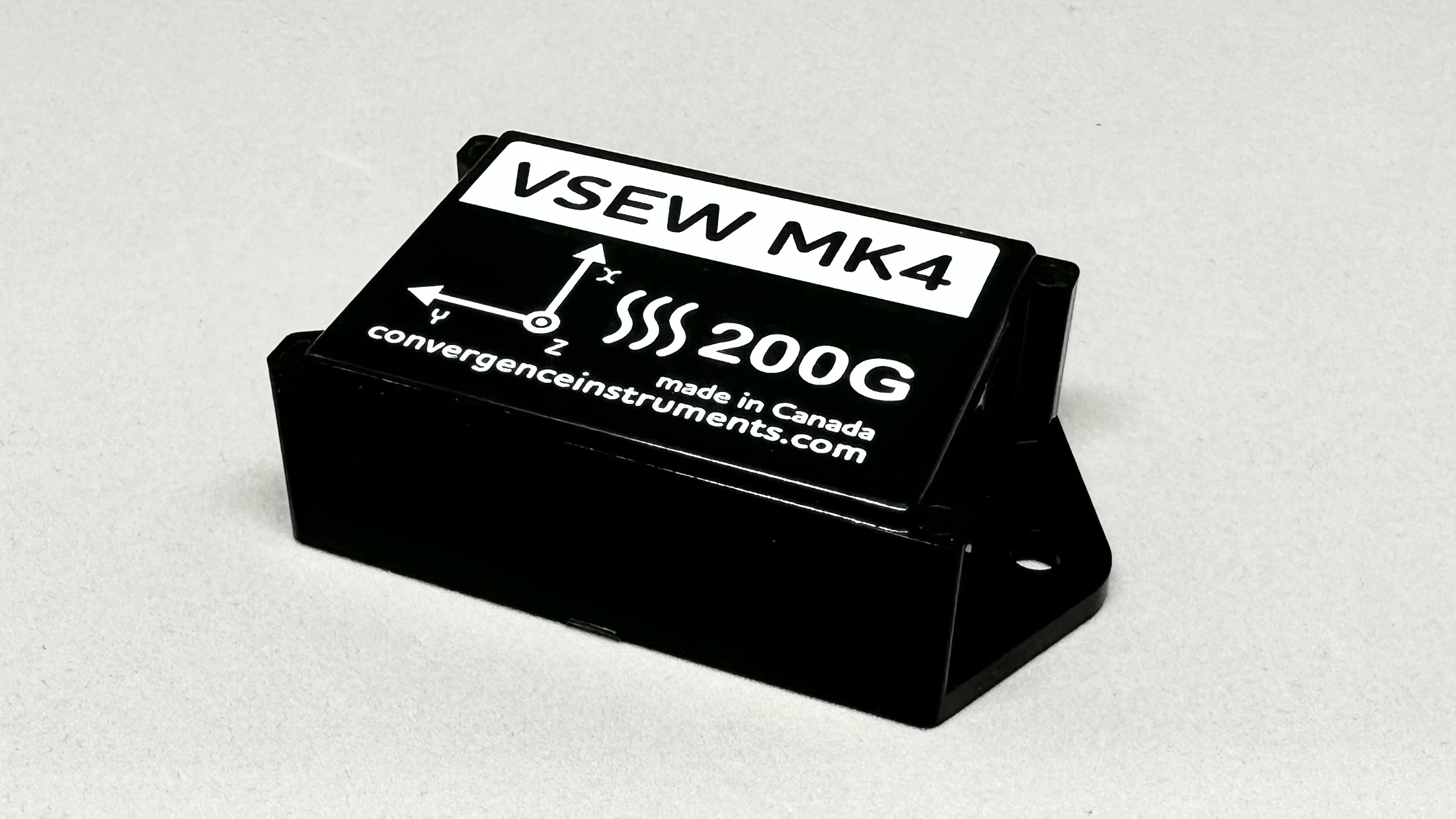
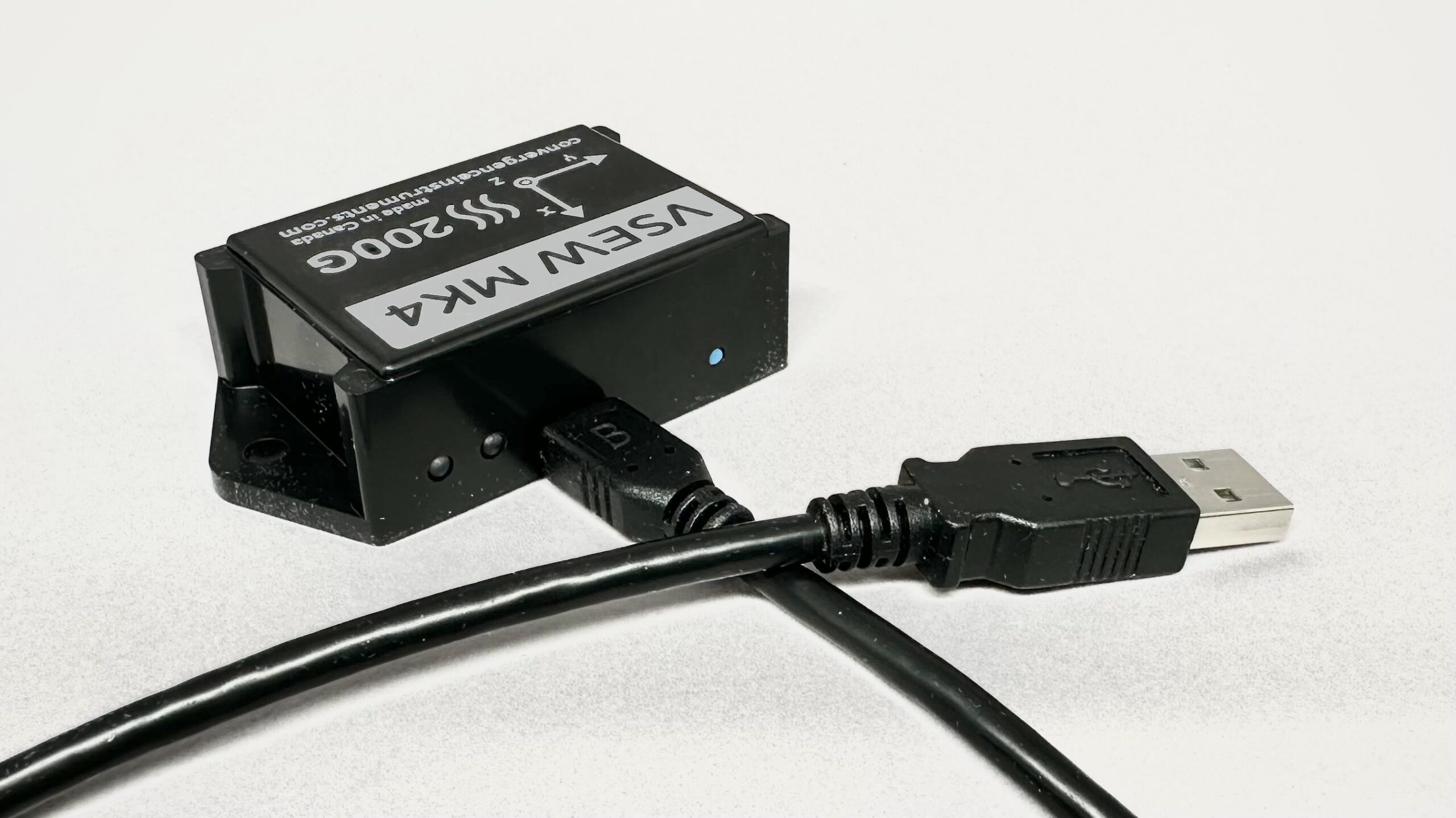
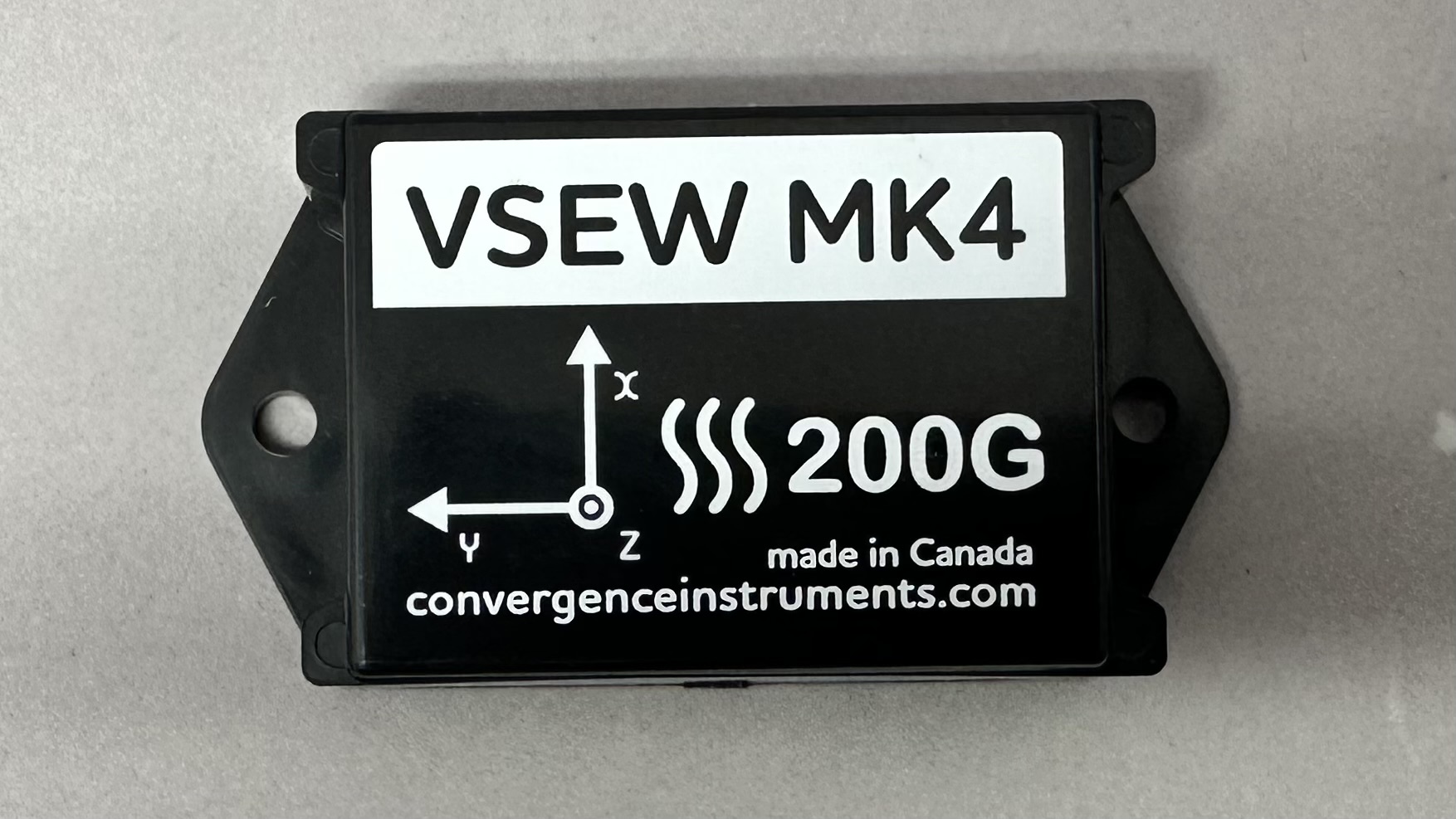
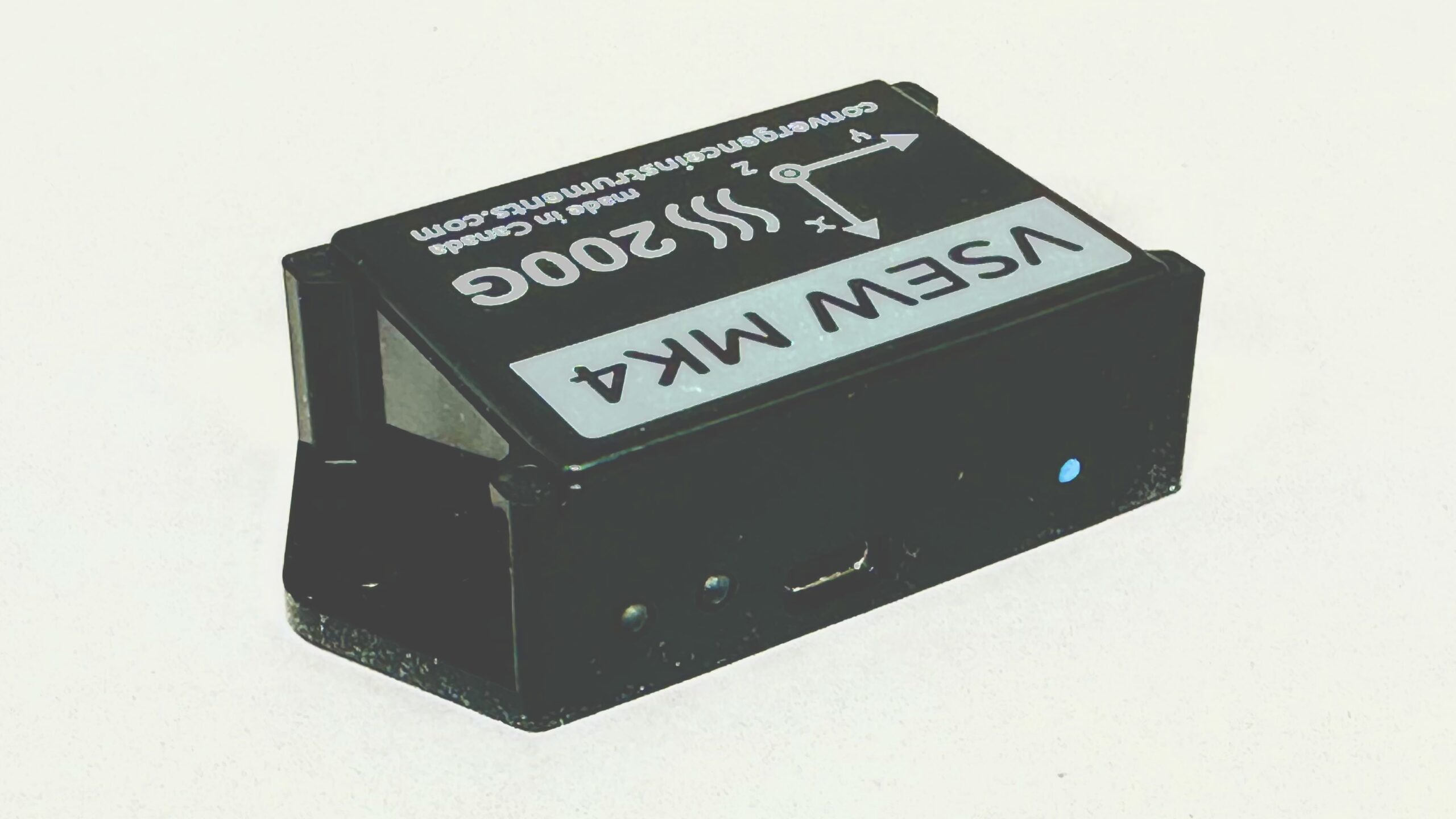
Wireless Vibration Meter Data Logger | VSEW mk4 200g
544.00 $


💥
High-g wireless vibration data logger.
The VSEW mk4 200g is designed for extreme acceleration events — impacts, drops, shocks and high-g road shipment monitoring. WiFi reporting, email alarms and velocity measurement included.
The VSEW mk4 200g is designed for extreme acceleration events — impacts, drops, shocks and high-g road shipment monitoring. WiFi reporting, email alarms and velocity measurement included.
The Vibration Meter Data Logger – VSEW mk4 200g is a high-range model in the VSEW mk4 series. It can record accelerations, vibrations, velocities and inclinations up to ±200 g. It includes a 3-axis MEMS accelerometer, an accurate date/time clock and a non-volatile 128 Mb recording memory.
The instrument features WiFi connectivity for remote data access, email alarms on acceleration or velocity thresholds, and an open USB VCP protocol for custom integration. It is self-calibrated using the earth's gravity as a reference.
New mk4 Features
- Virtual COM port interface for custom applications (VSEW mk4 Com Protocol)
- WiFi connection can use any open access point as fallback ("W" model)
- Email alerts can be sent to multiple addresses ("W" model)
💡
Need lower noise for ground vibrations or seismic monitoring? The VSEW mk4 8g offers an ultra-low noise floor (110 μg RMS) ideal for DIN4150-2 compliance and low-amplitude vibration monitoring. Also available with 24/7 Cloud Data Access.
Applications
- High-g impact and shock recording
- Road shipment monitoring — heavy cargo, package handling
- Drop testing and crash simulation
- Long-term measurement and recording of acceleration signals, velocity signals, and RMS levels
- Continuous monitoring of machinery wear in high-vibration environments
The Vibration Meter Data Logger – VSEW_mk4 – 200g is a new model in the VSE series of smart vibration dataloggers. It can record accelerations, vibrations, velocities and inclinations. It includes a 3-axis MEMS accelerometer, an accurate date/time clock and a non-volatile 128 Mb recording memory. Depending on the settings it can record acceleration or velocity signals and/or RMS levels for months. Its very small size allows it to be attached to, or embedded within, the monitored equipment.
The VSEW_mk4 has the following new features:
- Virtual COM port interface that allows configuration and measurements to be read by a custom application (see VSEW_mk4_Com_Protocol.pdf)
- Added filters and settings to support the DIN4150-2 and ISO2631-2 standards directly.
- WiFi™ connection can use any open access point if the specified access point is not working (“W” model only).
- Email alerts can now be sent to multiple addresses (“W” model only).
VSEW_mk4 Applications
- Shipment monitoring
- Long-term measurement and recording of acceleration signals, velocity signals, signal statistics (peaks and average) and RMS levels.
- Continuous monitoring of machinery wear.
- Shocks/impacts
In stock (can be backordered)
💥 Why the VSEW mk4 200g?
±200g dynamic range — captures extreme impacts and shocks
WiFi + email alarms — remote monitoring and threshold alerts
Velocity measurement — real-time velocity from acceleration
3-axis MEMS — acceleration, velocity, vibration, inclination
128 Mb memory — months of continuous recording
IP57 sealed — weatherproof, compact, self-calibrated
Key Features
The VSEW mk4 200g is designed for extreme acceleration events — impacts, drops, shocks and high-g road shipment monitoring.
💥
High-g
±200g Dynamic Range
Captures extreme impacts, drops and shocks that would saturate lower-range models. Designed for crash testing, heavy road transport and high-vibration industrial environments.
📡
WiFi + Email Alarms
Built-in WiFi reporting and email alarm notifications on acceleration, velocity and RMS thresholds. Multi-address alerts and fallback access point support.
📊
Velocity Measurement
Real-time velocity calculation from acceleration data. Record raw velocity signals, velocity statistics and RMS velocity levels. 1024-line spectrum display.
🛡️
IP57 Weatherproof
Integrally potted ABS enclosure protected against dust and temporary immersion. Compact and lightweight — deploy in the field, on machinery or inside cargo.
Product Description
The Vibration Meter Data Logger – VSEW mk4 200g is the high-range model in the VSEW mk4 series of smart vibration dataloggers. It can record accelerations, vibrations, velocities and inclinations up to ±200 g. It includes a 3-axis MEMS accelerometer, an accurate date/time clock and a non-volatile 128 Mb recording memory. Depending on the settings it can record acceleration or velocity signals and/or RMS levels for months. Its very small size allows it to be attached to, or embedded within, the monitored equipment.
New mk4 Features
- Virtual COM port interface that allows configuration and measurements to be read by a custom application (see VSEW_mk4 Com Protocol) NEW
- WiFi connection can use any open access point if the specified access point is not working ("W" model only) NEW
- Email alerts can now be sent to multiple addresses ("W" model only) NEW
Applications
- High-g impact and shock recording
- Road shipment monitoring — heavy cargo, package handling
- Drop testing and crash simulation
- Long-term measurement and recording of acceleration signals, velocity signals, signal statistics and RMS levels
- Continuous monitoring of machinery wear in high-vibration environments
VSEW mk4 200g Features
- Virtual COM port interface for custom applications (see VSEW mk4 Com Protocol) NEW
- 3-axis integral MEMS accelerometer
- Measures and records:
- Raw acceleration or velocity signals
- Acceleration or velocity statistics
- Vibration or velocity levels
- Inclinations
- All-digital design
- Integrated oscilloscope function — shows vibration or velocity signals in real time
- Allows observation of recorded data while recording is ongoing
- Works standalone, or USB or WiFi connected for setup and data transfer to PC
- Long-life internal rechargeable battery that recharges from USB
- Self-calibrated using the earth's gravity as a reference
- Observes and records 100% of the acceleration signals (no missed samples)
- Editable individual custom ID for easier instrument management
- Completely sealed weatherproof enclosure (IP57)
Specifications
| Sensor | |
| Number of Axes | 3 |
|---|---|
| Acceleration Sensor | MEMS Digital 3-axes |
| Dynamic Range | ±200 g |
| Bandwidth High Limit | Adjustable up to 1.6 kHz (@ 3.2 kHz Sampling Rate) |
| Bandwidth Low Limit | DC (High-Pass Filter Bypass), Adjustable from 10 mHz to Fs/2 (High-Pass Filter On) |
| Noise Performance | |
| Acceleration Noise (Typical) | 30 mg RMS @ 100 Hz Sampling Rate 150 mg RMS @ 3.2 kHz Sampling Rate |
| Velocity Noise (Typical) | 7 mm/s RMS @ 1 Hz High-Pass Cutoff 2.5 mm/s RMS @ 10 Hz High-Pass Cutoff |
| Connectivity | |
| Connectivity | USB (Virtual COM port with open protocol), WiFi ("W" model only) |
| WiFi Radio Standard | IEEE 802.11 b/g/n (2.4 GHz-only transceiver) |
| WiFi Certification | FCC, IC, Japan, Korea, CE |
| WiFi Band | 2.4 GHz band (Channels 1 to 11, 2412 MHz to 2462 MHz) |
| WiFi Max Power | 100 mW (20 dBm) |
| Measurements | |
| Measurements | Raw Acceleration (g or m/s²), Raw Velocity (m/s), Min/Max/Avg Acceleration (g or m/s²), Min/Max/Avg Velocity (m/s), Inclinations, Min/Max/Avg RMS Vibration level, Min/Max/Avg RMS Velocity level |
| Alarm Emails | Acceleration Signal Threshold (X, Y, Z), Velocity Signal Threshold (X, Y, Z), RMS Acceleration Level Threshold, RMS Velocity Level Threshold, Battery |
| Spectral Display | 3-Axes 1024-point Power Spectrum — dB or Lin Scale |
| Recording | |
| Duty Rate | 100% — No Missed Samples |
| Modes of Operation | Idle (Micro-Power), USB-Connected (Active), Recording (Stand-alone), Auto-Rec |
| Recording Memory | Non-Volatile Flash Memory — 128 Mb |
| Recording Capacity Examples | 17 min single-axis raw signals @ 4 kHz 5 days 3-axes full-statistics @ 1 s intervals 10 months 3-axes full-statistics @ 1 min intervals |
| Recording/Erasure Cycles | > 100,000 |
| Data Retention | > 20 Years |
| Timing & Calibration | |
| Sampling Clock Accuracy | 3% |
| Date-Time Clock Accuracy | 30 ppm |
| Calibration | Self-Calibration using the earth's gravity as a reference |
| Power | |
| Battery Type | Integral Li-Poly — USB-Rechargeable |
| Recharge Time | 2 h 30 (Typical) |
| Battery Autonomy | Up to 1 year in Idle 16 days to 125 days while recording, depending on settings |
| Battery Life | > 300 Charge/Discharge Cycles |
| Physical | |
| Temperature Range | −20 °C to 60 °C (−4 °F to 140 °F) |
| Weight | 65 g |
| Construction | Integrally Potted Weather-Proof ABS Enclosure |
| IP Rating | IP57 — Protected against dust and temporary immersion |
Talk to an expert
Which Model to Choose?
Which Vibration Meter Is Right for You?
Compare all Convergence Instruments vibration meters side by side
| VSEW mk4 8g | VSEW mk4 40g | VSEW mk4 200g This product |
VS E-16g | mk4 MQTT | |
|---|---|---|---|---|---|
| Price (USD) | $574 | $574 | $544 | $574 | |
| Product Page | View → | View → | — | View → | View → |
| Sensor & Range | |||||
| Dynamic Range | ±8 g | ±40 g | ±200 g | ±16 g | Depends on model |
| Memory | 128 Mb | 128 Mb | 128 Mb | 128 Mb | 128 Mb |
| Measures Velocity | ✓ | ✓ | ✓ | — | ✓ |
| Connectivity & Alerts | |||||
| Open USB Protocol (VCP) | ✓ | ✓ | ✓ | — | ✓ |
| WiFi Reporting | ✓ | ✓ | ✓ | — | ✓ |
| Email Alarms | ✓ | ✓ | ✓ | — | — |
| Visual Alarms | — | — | — | ✓ | — |
| Target Application | |||||
| Impacts | — | — | ✓ | — | DoM |
| Road Shipment Monitoring | — | ✓ | ✓ | ✓ | DoM |
| Inclinometer | ✓ | — | — | ✓ | DoM |
| Low-Amplitude Vibrations | ✓ | — | — | — | DoM |
| Ground Vibrations / Construction | ✓ | — | — | — | DoM |
| DIN4150-2 | ✓ | — | — | — | DoM |
| Machine Monitoring | ✓ | ✓ | — | ✓ | DoM |
| Raw-Signal Recording | ✓ | ✓ | ✓ | ✓ | ✓ |
| Noise Floor | |||||
| X-Y Axes | 110 μg @ 125 Hz 750 μg @ 4 kHz |
800 μg @ 125 Hz 4 mg @ 4 kHz |
31 mg @ 100 Hz 125 mg @ 3.2 kHz |
2 mg @ 100 Hz 10 mg @ 3.2 kHz |
DoM |
| Z Axis | 110 μg @ 125 Hz 750 μg @ 4 kHz |
800 μg @ 125 Hz 4 mg @ 4 kHz |
36 mg @ 100 Hz 160 mg @ 3.2 kHz |
3.6 mg @ 100 Hz 16 mg @ 3.2 kHz |
DoM |
Application Areas
The VSEW mk4 200g is designed for extreme acceleration events where lower-range models would clip.
💥
Impact & Shock Recording
Record extreme acceleration events — drops, collisions, impacts — that would saturate lower-range models. The ±200 g range captures the full waveform of high-g events, including the peak acceleration. WiFi and email alarms provide immediate notification when thresholds are exceeded.
±200 g
Drops & impacts
Email alarms
📦
Road Shipment Monitoring
Monitor heavy cargo and high-value equipment during road transport. The ±200 g range captures the full severity of road shocks, package handling impacts and loading/unloading events without clipping. Auto-rec mode preserves battery and memory for events that matter.
Road transport
Auto-rec
Heavy cargo
🔬
Drop Testing & Crash Simulation
Deploy in controlled test environments to record the acceleration profile of drop tests, crash simulations and mechanical shock testing. The 100% duty rate ensures no missed samples, and the 1024-line spectrum enables detailed frequency analysis of impact events.
Drop testing
100% duty rate
Spectrum analysis
⚙️
High-Vibration Industrial Environments
Monitor equipment in environments with very high vibration levels or occasional extreme events that would clip lower-range instruments. Record acceleration and velocity signals, statistics and RMS levels continuously for months. WiFi connectivity enables remote data access.
High-vibration
Velocity
WiFi
Vibration Meter Data Logger Buyer's Guide
What is the VSEW mk4 200g designed for?
The VSEW mk4 200g is designed for extreme acceleration events — impacts, drops, shocks and high-g road shipment monitoring. Its ±200 g dynamic range captures events that would clip lower-range models. For low-amplitude vibrations, ground vibrations or seismic monitoring, we recommend the VSEW mk4 8g with its ultra-low noise floor and DIN4150-2 support.
How does the 200g compare to other VSEW mk4 models?
All VSEW mk4 models share the same form factor, software and connectivity. The difference is the accelerometer range and noise floor: ±8 g for low-amplitude structural monitoring and DIN4150-2 compliance, ±40 g for medium-range road shipment and machine monitoring, and ±200 g for extreme impacts and crash testing. Choose the range that matches the maximum acceleration you expect to measure.
What software is included?
All Convergence Instruments software is free. The essential Instrument Manager handles configuration and data transfer. Optional tools include Wave Analysis, Speed & Displacement, PPV Analysis, VS Response Spectrum, Instrument Disk Recorder, Building Vibration Calculator, Auto Export, and VS Shipping Advisor for road shipment monitoring setup.
Can the 200g model measure velocity?
Yes. Like all VSEW mk4 models, the 200g calculates velocity in real time from the acceleration data. You can record raw velocity signals, velocity statistics (min, max, average), and RMS velocity levels. Email alarms can be configured on velocity thresholds as well as acceleration thresholds.
How long can the VSEW mk4 200g record?
With 128 Mb of non-volatile flash memory, the VSEW mk4 200g can record 3-axis full statistics at 1-minute intervals for up to 10 months, or at 1-second intervals for 5 days. Battery autonomy ranges from 16 to 125 days while recording, depending on settings. For indefinite deployment, connect a USB charger or solar panel. The auto-rec mode is ideal for impact monitoring — the instrument stays dormant and only records when acceleration exceeds an adjustable threshold.
5.0
Based on 1 review
| 5 star | 100 | 100% |
| 4 star | 0% | |
| 3 star | 0% | |
| 2 star | 0% | |
| 1 star | 0% |
1-1 of 1 review
-
 Michael P.Verified owner
Sorry, no reviews match your current selections
