
Professional Vibration Meters & Data Loggers
3-axis MEMS accelerometers with built-in data logging, WiFi & cloud connectivity. Support for DIN 4150-2 and ISO 2631-2. Weatherproof for permanent outdoor deployment. Starting at $249 USD.
Showing all 6 resultsSorted by price: high to low
-
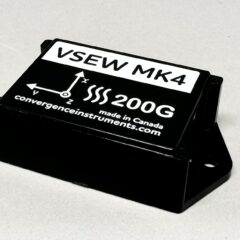
Wireless Vibration Meter Data Logger | VSEW mk4 200g
Rated 5.00 out of 5544.00 $ Add to cart -
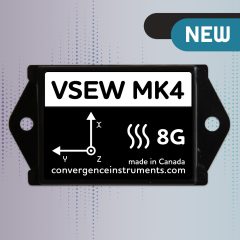
VSEW mk4 8g
Rated 4.00 out of 5574.00 $ Add to cart -
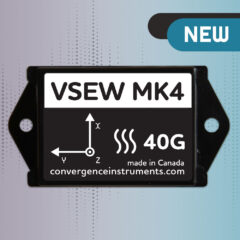
VSEW mk4 40g
574.00 $ Add to cart -
Sale!
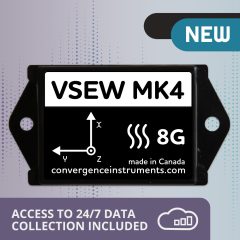
VSEW_mk4 8g with 24/7 Data Access (1 Year)
Rated 5.00 out of 5784.00 $Original price was: 784.00 $.695.03 $Current price is: 695.03 $. Add to cart -
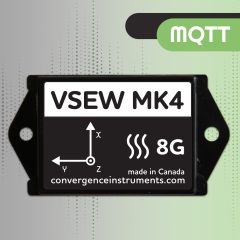
VSEW_mk4_MQTT
574.00 $ Add to cart -
Sale!
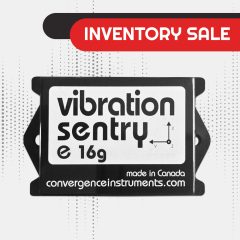
Vibration Sentry E-16g
349.00 $Original price was: 349.00 $.249.00 $Current price is: 249.00 $. Add to cart
Which model to choose?
Side-by-Side Comparison
All models: 3-axis MEMS accelerometer, 128 Mb memory, self-calibrated, weatherproof, free software with lifetime updates.
| Feature | VSE E-16g | VSEW mk4 8g | VSEW mk4 40g | VSEW mk4 200g |
|---|---|---|---|---|
| Best For | Inclination | Seismic & long-term remote monitoring |
Medium-range vibration |
Shocks and high-g events |
| Accelerometer Range | ±16g | ±8g | ±40g | ±200g |
| WiFi Connectivity | — | ✓ | ✓ | ✓ |
| Cloud Data Access | — | Optional (+cloud) | Optional (+cloud) | Optional (+cloud) |
| Support for DIN 4150-2 / ISO 2631-2 | — | ✓ | ✓ | ✓ |
| Velocity Calculation | — | ✓ | ✓ | ✓ |
| Email Alerts | — | ✓ | ✓ | ✓ |
| Auto-Record Trigger | ✓ | ✓ | ✓ | ✓ |
| Open USB Protocol | — | ✓ | ✓ | ✓ |
| IP57 Weatherproof | ✓ | ✓ | ✓ | ✓ |
| Price | $249 | $574 | $574 | $544 |
| Details | Details | Details | Details |
Built for Every Vibration Monitoring Need
Construction & Blasting
Ground-borne vibration monitoring with DIN 4150-2 support and cloud alerts
Shipping & Transit
Shock and tilt logging for fragile equipment during transport with auto-record trigger
Machine Health
Continuous vibration monitoring for predictive maintenance and machinery wear detection
Seismic & Research
Long-term seismic monitoring, inclination tracking, and ISO 2631-2 building vibration studies
Everything You Need to Know About Vibration Meters
Choosing the right vibration meter depends on the acceleration range, connectivity, standards support, and your specific monitoring scenario.
Our engineers can help you select the right vibration meter and accelerometer range for your application.
Contact Our Team →Vibration Meter Buyer's Guide
How to choose your vibration meter
How to Choose Your Vibration Meter
Choosing the right vibration meter depends on your specific requirements. Are you monitoring ground borne vibration, machine vibrations, or conducting scientific studies? Consider the range, accuracy, cost, datalogging, recording time, and additional features like weather-resistance or wireless connectivity. Our vibration meters offer various options to meet these diverse needs.
Applications of a Vibration Meter
Vibration meters are vital tools in numerous fields. They ensure monitoring of construction vibration limits, track machinery health for predictive maintenance, log shipping conditions for fragile equipment, and support research in seismic monitoring and building vibration assessment. Our products excel in these diverse applications.
Features of a Vibration Meter
Modern vibration meters come with advanced features. Look for models with selectable frequency weightings and adjustable filters for precise measurements tailored to different standards and applications. Some vibration meters can calculate velocity from the acceleration signal for various building vibration applications. Data logging capabilities enable continuous monitoring over time. Wireless and cloud connectivity add convenience for remote monitoring.
Types of Vibration Meter
Vibration meters vary based on functionality and application. Basic models measure acceleration signals while advanced models provide averaged vibration levels or peak levels over time. Data logging meters store measurements and signals for later analysis. Our range covers USB-only for portable use and WiFi-enabled for permanent remote installations.
Accelerometer Ranges Explained
The ±8g range provides the lowest noise floor for low-level vibrations like seismic events and building monitoring. The ±40g range covers very high vibration amplitudes. The ±200g range is designed for high-g events like shocks, impacts, and road transport monitoring. Note that a higher range will reduce sensitivity, so all our models use 3-axis MEMS accelerometers that self-calibrate using Earth's gravity.
Choosing the Right Model for Your Needs
For short-term or road transport monitoring, choose the affordable VSE E-series (USB, from $249). For long-term remote monitoring with WiFi, email alerts, and DIN/ISO support, choose the VSEW mk4 series. Add cloud service for browser-based access from anywhere. For OEMs needing MQTT integration, the VSEW_mk4_MQTT offers an open wireless protocol.
Standards Support: DIN 4150-2 & ISO 2631-2
Our VSEW mk4 series includes built-in filters and settings to support DIN 4150-2 (evaluation of vibration effects on people in buildings) and ISO 2631-2 (evaluation of human exposure to whole-body vibration) directly. The instruments calculate the required acceleration or velocity metrics automatically from the acceleration signal, eliminating the need for manual post-processing. This makes them ideal for construction vibration monitoring, blasting assessment, and building occupant comfort studies.